


Search Results for "wedding 1895"
MacNeil-Brooks Wedding Reception – Christmas Day 1895
Posted by: | CommentsOne Hundred and twenty-three years (123) ago, Hermon Atkins MacNeil and Carol Louise Brooks were on married Christmas Day.
Recently an invitation to their Wedding Reception came available from the estate of Walter Pratt. He was a first cousin of Hermon. A facsimile appears below.

Noteworthy, is the location of the reception: the “Studio 1733 Marquette Building Chicago, Adams and Dearborn Streets, Chicago”. Recovery of this printed invitation adds several previously unknown facts to the story of their wedding day. The 19th Century Marquette Building is the 21st Century home of the John D. and Catherine T. MacArthur Foundation.
The wedding earlier in the day was a private ceremony. Rev. Edward F. Williams, a Congregational Minister, officiated. Their license, completed in Rev. Williams hand, appears below.

“Marriage: On Christmas Day 1895, in Chicago, he married Carol Louise Brooks, also a sculptor (see their marriage record below). Earlier MacNeil was informed that he had won the Rinehart Roman Scholarship. Following their wedding, the pair left for Rome, passing three years there (1896-1899) and eventually spend a fourth year in Paris where their first son, Claude, was born. During those years they studied together under the same masters and shared the income of the Rinehart scholarship awarded to Hermon. (Carol had also studied sculpture with both Lorado Taft and Frederick William MacMonnies).”
Both Carol and Hermon sculpted for the Chicago World’s Fair of 1893. Carol Brooks was one of Lorado Taft’s “White Rabbits”
Lorado Taft’s “White Rabbits” https://en.wikipedia.org/wiki/White_Rabbits_(sculptors)
Hermon sculpted statues on the Electricity Building (See picture below)


Carol Brooks MacNeil – 1907 – Twelve years after her marriage to Hermon 
H.A.MacNeil ~1895 sketch – The Sun (New York City) 
The Electricity Building housed the Tower of Light, displays by Western Electric, General Electric, American Bell Telephone, Edison’s lasest phonographs. 
The White City Columbian Exposition: http://members.cox.net/academia/cassatt8.html 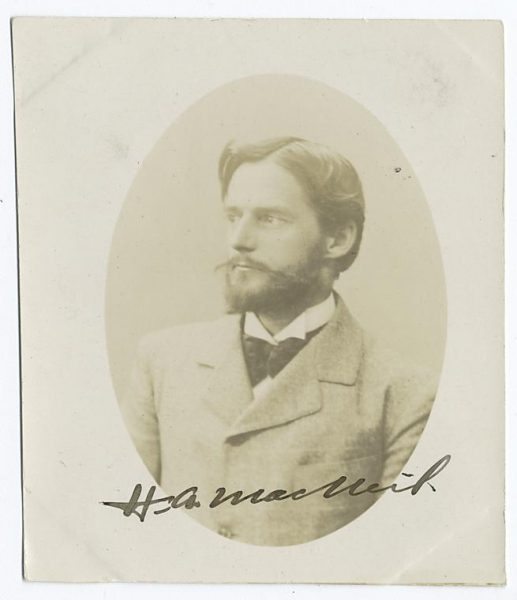
New York Public Library – Digital Gallery (655 x 760) 
H.A. MacNeil “Fan Club” Members examine the Marquette Building – 140 S. Dearborn Ave. 
Panel 4 “The de Profundus was intoned 
Panel 3 “Passing two leagues up the river …” 
Panel 2 ” To follow those waters …” 
“To follow those …” Panel 1

Related posts:
- ~ ~ ~ “The Most Happy Young Man I Know” ~ ~ ~ ~ ~ ~ ~ Hermon A. MacNeil ~ Success & Marriage! (13) 1895 Hermon Atkins MacNeil, American Sculptor (1866-1947) MacNeil’s bronze of…
- Hermon MacNeil ~ “The Most Happy Young Man I Know!” (10) ~ Christmas Day 1895 ~ In 1895, Amy Aldis Bradley…
- Hermon MacNeil at the 1893 Columbian Exposition ~ ~ ~ THE CHICAGO YEARS ~ ~ (9) CHICAGO YEARS: Partners and Colleagues When Hermon MacNeil came home to the…
- “PRIMITIVE INDIAN MUSIC” ~ Part 3: 1894 Eda Lord’s Ticket to the Chicago World’s Fair (9) Eda Lord, (the woman who purchased the MacNeil bronze statue,…
- The MacNeil’s Chicago Wedding – Christmas Day 1895 (9) I sit here in Chicago during this Christmas Season, imagining…
- MacNeil – Brooks 120th Anniversary (1895-2015) (7) On Christmas Day one dozen decades ago, Hermon A. MacNeil…
Related Images:
The MacNeil’s Chicago Wedding – Christmas Day 1895
Posted by: | CommentsI sit here in Chicago during this Christmas Season, imagining a Christmas wedding ceremony one hundred and nineteen years ago.
~
On Christmas Eve day in 1895, Hermon Atkins MacNeil and Carol Louise Brooks purchased a Cook County license to solemnize their marriage. The very next day, Christmas 1895, they shared their vows before God and a Congregational minister named, Edward F. Williams, here in Chicago. The record looks like this:

Marriage License of Hermon Atkins MacNeil and Carol Louise Brooks issued on December 24th, 1895 and completed on Christmas Day 1895 by Rev. Edward F. Williams, Congregational Minister.
Both Hermon and Carol were sculptors. Hermon had completed 4 bronze relief sculpture panels for the new Marquette Building. They had fellow friends among the art community, sculptor colleagues from the Chicago World’s Fair, students and teachers from the Art Institute of Chicago, and “White Rabbits” team of women sculptors. We don’t have any record of who might have witnessed their nuptials.
~
But it was Christmas Day, a time when families gather. Hermon’s family was far away in Massachusetts. Carol’s was born in Chicago and studied there at the Art Institute with Lorado Taft working on the 1893 Worlds Fair with her “White Rabbit” colleagues. Perhaps some friends or family were present or even hosted some wedding celebration. Her parents were close enough to be present, but no evidence suggests that. It appears to have been a quick, quiet, modest ceremony. The less than a one-day turn around on their marriage license would support that. In addition, we know that they sailed a week later for Rome and Hermon’s Roman Reinhart Scholarship studies there. A December 22, 1895 – New York Sun, article (CLICK HERE) supports that as well as a letter from Amy Ardis Bradley [ CLICK for MORE ]
~

New York Sun December 22, 1895 “The Reinhart Prize Winner ~ Hermon Atkins Macneil of Chicago”
The officiating minister, Rev. Edward (Franklin) Williams appears to have been a prominent clergy described as “a Congregational minister, educator, field agent for the United States Christian Commission, missionary, and writer.” ( Source: Edward Franklin Williams papers, Amistad Research Center at Tulane University, New Orleans, Louisiana ) He wrote Carol’s name as “Carrie” in his handwritten certification on the bottom of the license. She went by ‘Carrie’ among her friends.
~
Whether Rev. Williams considered her a ‘friend’ we do not know. Philip Khopf, the Cook County clerk, wrote ‘Carol’ in the top portion of the certificate. Rev. Williams could have copied “Carol” from the official record above, but chose to use ‘Carrie’ instead. The license lists Carol as being 24 years of age and Hermon as 29. We know that the minister was 63 years of age when he led their ceremony. Until 1891 he was pastor of the South Congregational Church, in suburban Chicago. For health reasons he had “an extended stay abroad (June, 1891 to July, 1893), primarily in Germany, where he pursued studies in Berlin.” Returning to Chicago he studied and lectured at Chicago Theological Seminary during 1894.
~
Whether Rev. Williams had some previous knowledge with Carrie and Hermon or was a friend of the family, is uncertain. He seemed very connected to the Chicago community and many of the potential benefactors of the arts. At a minimum, his use of “Carrie” seems to indicate a ‘cordial’ style of ministry and interaction. It also seems consistent with his servant-attitude toward needs of the soldiers and wounded he encountered during the Civil War.
~
CLICK HERE for more Links and info about Hermon and Carrie’s marriage in 1895:
~
More biographical information on Rev. Williams is offered below.
Williams, Edward Franklin (1832-1919)
Historical Note: Edward Franklin Williams was a Congregational minister, educator, field agent for the United States Christian Commission, missionary, and writer. Edward Franklin Williams was born in Massachusetts in 1832, the son of Delilah Morse Williams and George Williams. Williams attended Yale University from 1852 to 1856, and he continued to earn an advanced degree from Yale. He later attended the Princeton Theological Seminary, where he graduated and earned his license to preach in 1861.Williams was exempt from the draft due to a tubercular condition in his lungs, and thus he did not fight in the Civil War. In April 1863, Williams received a commission as a field agent for the United States Christian Commission. With the Commission, he served two and a half years in the armies of the Potomac and the James.After the war, Williams was sent as principal to begin was became the Lookout Mountain Educational Institutions in Chattanooga, Tennessee. In 1867, Williams was appointed by the American Missionary Association to teach in the Normal and Preparatory Division of what was later Howard University. He left Howard to preach at several churches in Massachusetts, Pennsylvania, Illinois, and New York, ultimately serving as pastor of Tabernacle Church in Chicago and Forty-Seventh Street Congregational Church, which later became South Congregational Church, in suburban Chicago, where he served until 1891.By 1880, Williams was writing a monthly column for The Congregationalist under a pen name, “Franklin.” He continued writing for this publication until 1908. He continued as a prolific writer, particularly in the 1890s.
From 1901 to 1911 Williams served as pastor of the Evanston Ave. Congregational Church in Chicago. Williams died in 1919 in Chicago.
[ Sources: Edward Franklin Williams papers, Amistad Research Center at Tulane University, New Orleans, Louisiana ]
Related Images:
Christmas Day 2025: Is the 130th Wedding Anniversary of Hermon & Carol Brooks MacNeil
Posted by: | Comments2025
The “Sculptors MacNeil” were wed in 1895 in Chicago. Christmas Eve marked the 130th Anniversary of their nuptials…
As well as, … my 15th year as Webmaster/Host of www.HermonAtkinsMacNeil.com . These words are my 326th posting of their life and work together as the “Sculptors MacNeil”.
Wow! I never expected to create such a vast & virtual compendium of my “Uncle Hermon.” He and my grandfather Tom Henry McNeil were actually cousins. But he told his four children to address him as “Uncle Hermon.”
 Their wedding reception was held in Hermon’s new studio in the Marquette Building. They would enter through the doors where his four bronze panels of the life of Fr. Pere Marquette were installed. Here is how they look after cleaning and re-installation several years ago.

Married in a private ceremony on Christmas Day Hermon and Carol MacNeil had a reception in the Marquette Building

Etching of young Carol Louise Brooks by William Harry Warren Bicknell ~ about 1891 ~ four years before her marriage to Hermon A. MacNeil. Bicknell was a colleague of her painter-father, Alden Brooks.

Marriage License of Hermon Atkins MacNeil and Carol Louise Brooks issued on December 24th, 1895 and solemnized on Christmas Day 1895 by Rev. Edward F. Williams, the Congregational Minister of the Brooks family in Winnetka, Illinois, north of Chicago.
Related Images:
Christmas Eve 1895.
Chicago, Illinois
There was a Wedding in …
Hermon MacNeil’s Studio
~ 1733 Marquette Building ~

Married in a private ceremony on Christmas Day Hermon and Carol MacNeil had a reception in the Marquette Building

Carol Louise Brooks as a young girl. An Etching by William Harry Warren Bicknell. (about 1891)
~
Every Christmas we remember this
Special Christmas Day Wedding of two sculptors.
They met in Chicago, Carol’s hometown as they sculpted the “White City” of The Worlds Columbian Exposition (aka. Chicago Worlds Fair). That event opened in May 1893.
Hermon made figures on the Electricity Building. Carol (Carrie) was a student of Lorado Taft and became a “White Rabbit”, that group of select females permitted to sculpt as the deadline for opening day loomed closer.
Two years later Hermon, age 29, proposed to Carol (Carrie) just 24. She accepted. They got a Marriage License on Christmas Eve and used it the next day. Several weeks later they sailed to Rome where Hermon had accepted the Reinhart Fellowship and they both continued to learn sculpture for 3 years. And then spent a a fourth year in Paris.
~ Christmas Day 1895 ~
In 1895, Amy Aldis Bradley wrote of Hermon MacNeil:
“…The young sculptor was married on Christmas Day, and sailed for Rome on Wednesday, and is, on the whole, the most happy young man I know.” (http://marquette.macfound.org/slide/herman-macneil/ )
One hundred and twenty-five Christmas Days ago, Hermon Atkins MacNeil and Carol Louise Brooks were united in marriage in Chicago, Illinois by Rev. Edward F. Williams, a Congregational Minister. They purchased their Marriage License on Christmas Eve Day 1895 & made their Vows on Christmas. [CLICK HERE to See their License]
 Related Post: The-Most-Happy-Young-Man-I-Know/
Both Hermon and Carol were sculptors who worked on the 1983 Chicago World’s Fair (World’s Columbian Exposition). Just days earlier MacNeil received word that he had won the Rinehart Roman Scholarship. (Carol had also studied sculpture with both Lorado Taft and Frederick William MacMonnies). Within the week, the pair left for Rome, passing three years there (1896-1899). It was a romantic time of study together under the same masters. With frugality, the income of Hermon’s Rinehart scholarship supported them both. They travelled through Italy occasionally bartering a room for sculpture. They spend a fourth year in Paris.”
According to information from the MacArthur Foundation (current owner and curator of the Marquette Building), Amy Aldis Bradley’s complete words in 1895 to Peter Brooks:
After commissioning MacNeil for the exterior bronzes, Aldis wrote to Peter Brooks, “McNeil’s [sic] panels are being placed in position. It is greatly to their and his credit that these bas-reliefs have won for him the Roman [Reinhart] Fellowship. The Commission, choosing him as the best of the very young men…The young sculptor was married on Christmas Day, and sailed for Rome on Wednesday, and is, on the whole, the most happy young man I know. He is very grateful to the owners of the Marquette Building.” (http://marquette.macfound.org/slide/herman-macneil/ )
Related Images:
Merry Christmas – 124th Anniversary of Hermon and Carrie Brooks MacNeil’s Wedding Day.
Posted by: | Comments
By The original uploader was TonyTheTiger at English Wikipedia.(Original text: en:User:TonyTheTiger) – Self-photographed, CC BY-SA 3.0,
https://commons.wikimedia.org/w/index.php?curid=3588095

Carrie as a young girl. Ink drawn portrait by HW Bucknell in 1892 for her parents.

They had a wedding reception in the Marquette Building in the Studio of Hermon Atkins MacNeil.
The Brooks of Winnetka, Illinois hosted the reception for Carol (“Carrie” to her friends) and the “happiest man in the world” – her new husband – “Hermon Atkins MacNeil”.
Carrie’s father and mother, Alden F. and Ellen T. (nee, Woodworth) Brooks lived at 518 Elder Lane, Winnetka. He was a portrait painter for whom President William McKinley once sat. Hermon would later sculpt the memorial statue of William McKinley at the Columbus, Ohio Capitol Building. McKinley was assassinated in 1901 at the Buffalo Worlds Fair.
Carrie preferred sculpture to painting, though she grew up in her parents home with a great awareness and appreciation of the arts and Chicago community, and the Chicago Art Institute.

A 2019 photo of the home where Carrie Brooks parents lived when he died at 93 years of age in 1932. The home still stands at 436 Elder Lane and Woodlawn avenue, in the north shore Chicago suburb of Winnetka, Illinois. The neighborhood appears very original and well maintained even today. They lived elsewhere in Hyde Park when they hosted the wedding reception for Carrie and Hermon 124 years ago.
Happy Christmas Memories
Merry Christmas
and
Happy Anniversary
( X 124) to the MacNeil Sculptor Couple
our favorite Christmas Coupe Today!
Invitation below…
↓

Here is the printed invitation for the Brook’s Christmas Day reception for Carol (Carrie) and Hermon MacNeil at the Marquette Building
Related Images:
MacNeil – Brooks 120th Anniversary (1895-2015)
Posted by: | Comments
Carol Brooks MacNeil – 1907 – Twelve years after her marriage to Hermon

H.A.MacNeil ~1895 sketch – The Sun (New York City)
On Christmas Day one dozen decades ago, Hermon A. MacNeil and Carol Louise Brooks were married in Chicago, Illinois. The pair were both sculptors who met while working on the World’s Colombian Exposition of 1893, better known as the Chicago World’s Fair.
Carol was a student of Lorado Taft and became one of the White Rabbits. These female sculptors were hired (commissioned) to help finish the 100’s of sculptures needed to finish the buildings, fountains, arcades, for the White City of the Chicago Worlds Fair.
Previous postings celebrate this MacNeil-Brooks Wedding:

Eda Lord’s Chicago World’s Fair Ticket from ‘Chicago Day.’ (Her great-great grandson, Jim Dixon found it an a box of her memobilia from the era when she bought her MacNeil sculpture.)
Related Images:

"Hermon Atkins MacNeil" in studio smock. A portrait by Milton Herbert Bancroft
In December 1895,

"The de Profundus was intoned ..." (detail from right side of Panel 4).
- Hermon Atkins MacNeil’s four bas relief panels depicting the life of Fr. Pére Marquette were put in place on the new Marquette Building in Chicago.
- He received word that he had been awarded the Rinehart Prize for study in Rome.
- On Christmas Day he married Carol Louise Brooks, a sculptor herself, who studied with MacNeil and shared many of the same colleagues.
Carol Brooks MacNeil - 1907 - Twelve years after her marriage to Hermon
- On New Years Day, or there about, they sailed for Rome and what would become 3 years of further study there, then going to Paris for a fourth year and exhibiting at the Exposition Universelle of 1900.
While we can imagine Hermon Atkins MacNeil’s state of mind in December 1895 to be quite elated, we have actual historical reference on MacNeil’s mood written by Amy Aldis Bradley, another artist friend who completed art for the Marquette project.
Amy Aldis Bradley wrote in 1895 to Peter Brooks, developer for the new Marquette Building in Chicago and employer of her father, stating the following:
“McNeil’s [sic] panels are being placed in position. It is greatly to their and his credit that these bas-reliefs have won for him the Roman [Rinehart] Fellowship. The Commission, choosing him as the best of the very young men…The young sculptor was married on Christmas Day, and sailed for Rome on Wednesday, and is, on the whole, the most happy young man I know. He is very grateful to the owners of the Marquette Building.” (Based of information from the MacArthur Foundation, current owner and curator of the Marquette Building, cited at their website: (http://marquette.macfound.org/slide/herman-macneil/ )
Marriage License of Hermon Atkins MacNeil and Carol Louise Brooks issued on December 24th, 1895 and completed on Christmas Day 1895 by Rev. Edward F. Williams, Congregational Minister.
Hermon and Carol obtained a marriage license on Christmas Eve Day (Dec. 24th). They were married on Christmas Day. The dates seem to imply that they had a wedding ‘not long in the planning.’
Christmas Day in 1895, fell on a Wednesday. The following Wednesday, of course, was New Years Day. We do not have other confirmation that they sailed on New Years Day for France, but it seems to be consistent with plans to go to Rome quickly. The article below was written on December 19th, then published on December 22, 1895 in the NY Sun. The reporter states that MacNeil would like to leave for Rome in about a week. That is consistent with the other evidence.
We know that MacNeil inquired of the Rinehart Committee if he could still fulfill the Rinehart Award conditions if he was a married man. They suggested that it would be a one year award under those conditions. As it turned out he was given three years. We do not know if he their fourth year spent in Paris was at their own expense or financed on their own.
The full text of the December 22, 1895 article that appeared in the New York Sun is posted below. In it the reporter states:
“When found in his studio yesterday, the young sculptor was busily at work on a crude mass of clay, from which were gradually emerging the features and forms of a Pueblo Indian. He was surrounded by a miscellaneous assortment of tools, plaster, and casts. He left his work to discuss his good fortune.”
Here is is in its entirety. Enjoy!
December 22, 1895 – New York Sun, (CLICK HERE) see columns 5 and 6

New York Sun December 22, 1895 "The Rinehart Prize Winner ~ Hermon Atkins MacNeil of Chicago"
Related Images:
Albany – The Women Assisting Hermon MacNeil
Posted by: | CommentsJoel Rosenkranz shared notes naming people, all women, who assisted MacNeil in the creation of the Albany memorial as he sculpted the clay models at his Studio in College Point

Perhaps the he Drummer Boy has a feminine touch
Joel shared research notes listing Female names of Sculptor Assistants who worked on the model of the Albany Monument. [Source: 1922Oct16-AlbanyMem-HaasNotes ]
Joel states:
Some of the surnames will be familiar and maybe some of the given names as well. Their ages range from 21 to 46, which is an interesting span. I looked at the memorial and all the figures except the nine foot woman are men as far as I can tell. Do you think he used women as models for the soldiers and sailors? [Perhaps the Drummer Boy came from feminine hands and talents? dnl].
Here is a little about each if you ever plan to develop a story behind the piece.
He adds the following research into Hermon’s cadre of feminine artists and neighbors:
Katherine Breck lived in the village Flushing to the south of College Point. She was 41 and the wife of George Breck, the artist who you undoubtedly know. In 1910 he was still in Rome.
Emily DeNeufville was the twenty-two year-old daughter of August who was a stockbroker and an artist as well. In time she married a gent named Colman Wynne.
Lena Schiiler (46) and Bianca Schiiler, (54) were both single women, teachers. I don’t think either ever married.
Mercy Clare is probably Mary Clair the 21 year-old daughter of Francis Clair who owned an insurance company and was an important man in the life of College Point. A politician as well, he lived next door to HAM.
The Bardenhauer women, Clara, 44, and Alvina, 46, also lived near him. The former was a teacher at Flushing H.S. , and after leaving a College Point elementary school, Alvina taught German in nearby Newtown H.S. in Elmhurst. It does not appear either ever married and Alvina died at the age of 81 in 1944.
In 1911 Irma Weitling 18, was another assistant. Her father William Weitling was head accountant at the Poppenhusen Rubber factory. In time he would become president only to die in a car accident in Florida in 1932.
Mrs. Edwin Charles was the wife of the artist/painter who you probably know. I found a few of his paintings via google and liked them.
Alice Clark was a 29 year-oild kindergarten teacher probably in College Point. She lived in the Graham Mansion, a storied piece of property about which I’ve written once owned by Captain Graham. Some said there were underground railroad tunnels under his property, but I don’t think there were.
There were a few women named Florence Tyler living in Queens, but without another a fact or two, I can’t say which one would have assisted Hermon MacNeil.
To these names given by Joel Rosenkranz, I would add another:
Carol Brooks MacNeil
Carol Brooks MacNeil as Hermon’s first female assistant, and sculptor-partner for life, she was always there. I imagine that she added clay modeling and teamwork skills to the efforts of these dozen women. Many hands completed the manifold tasks that produced this sparkling marble monument and over eighty bas relief figures.


Soldiers and Sailors’ Monument (reverse) in Washington Park, Albany NY
Hermon MacNeil’s Female Assistants for Albany Work
-
-
- Alice Clark
- Alvina Bardenhauer
- Bianca Schiiler
- Carol Brooks MacNeil
- Clara Bardenhauer
- Emily DeNeufville
- Erma Weitling
- Florence Tyler
- Katherine Breck
- Lena Schiiler
- Mercy Clare
- Mrs Edwin Charles
-
Related posts:
- 1912 Albany Honors Their Own (8.3) Celebrating Hermon MacNeil’s 159th Birthday Anniversary 1866-2025 Albany’s Civil War…
- Albany NY – Soldiers and Sailors Monument (7.8) In Albany New York just north of the Capitol Building…
- MacNeil’s “Standing Liberty Quarter” and “I’ve Got a Secret” April 4, 1966 (7.1) 100 years after the birth of Hermon MacNeil and fifty…
- The Portrait “BUST” of HERMON A. MacNEIL ~ by Jo Davidson ~ Unveiled for MacNeil Month 2021 ~#5 (7) AT LAST, the UNVEILING of the 75-YEAR-OLD PORTRAIT BUST OF…
- “Chief of the Multnomah” ~ DO WE HAVE ONE? ~ ??????? (6.8) Last summer I received an email from Linette Porter-Metler of…
- MacNeil – Brooks 120th Anniversary (1895-2015) (6.7) On Christmas Day one dozen decades ago, Hermon A. MacNeil…
Related Images:
Christmas and the 128th “MacNeil Anniversary”
Posted by: | CommentsChristmas Eve 2024 marks the 128th Anniversary of the Wedding of the “Sculptors MacNeil.”
 On
 Christmas Eve 1895, Hermon Atkins MacNeil and Carol Louise Brooks were joined in marriage in Chicago.
WE have told their wedding story here dozens of times.
Click this LINK TO READ those many postings.
- See their Marriage License from Christmas Eve,
- Read their Reception Invitation from Christmas Day,
- See WHERE the reception was Held,
- See how the County Clerk wrote “Carol” as bride:
- But Pastor Williams wrote “Carrie” on the license, (He knew her nickname !)
- Read how the “News” was published in so many papers.
ITS ALL HERE on THE CHRISTMAS POSTS
at HermonAtkinsMacNeil.com/
and have yourself
a Merry, Happy, Bless-ed Christmas season
Related Images:

BACK ROW (lt. to rt.) George Maher, Elizabeth Brooks Maher (I always called her Aunt Bess. I was 16 when she died.), Carrie, Arthur Wyld (my grandfather) and Hermon. On the front row, Frances Brooks Wyld (my grandmother), Ellen Woodworth Brooks (my great grandmother) and Alden Finney Brooks (my great grandfather).
After contacting
Carolyn Saul,
I sent her a family photo
of MacNeil-Brooks faces
that I thought
she could recognize.
~ ~ ~ ~ 0 ~ ~ ~ ~
and sure enough here’s what she said …
In the back row (left to right) Carolyn named her relatives :
- George Maher and
- Elizabeth Brooks Maher (Carolyn’s Aunt Bess)
- Carol Brooks MacNeil (Carolyn’s Great Aunt ‘Carrie’)
- Arthur Wyld (Carolyn’s grandfather)
- Hermon MacNeil (Carolyn’s great uncle by marriage)
Seated in the front row:
- Frances Brooks Wyld (Carolyn’s grandmother),
- Ellen Woodworth Brooks (Carolyn’s great grandmother) and
- Alden Finney Brooks (Carolyn’s great grandfather)
CAROLYN CONTINUED WITH:
Thanks for the photo, too. You probably already know, but the people in the area photo are George Maher, Elizabeth Brooks Maher (I always called her Aunt Bess. I was 16 when she died.), Carrie, Arthur Wyld (my grandfather) and Hermon. On the front row, Frances Brooks Wyld (my grandmother), Ellen Woodworth Brooks (my great grandmother) and Alden Finney Brooks (my great grandfather).
I received the last medallion, thank you! I loved The Galley issue you sent. I appreciate you including it. You have a long way to drive from South Dakota to Virginia! I would love to meet you the next time you come through this way.
Related posts:
- Hermon Atkins MacNeil: BIOGRAPHY Published !!! (3) Author and historian, James E. Haas has completed “Hermon Atkins…
- MacNeil Medallion finds Carolyn Saul (the Grand Niece of Carrie Brooks) ~~ And Lore of ‘Tortoise & Hare’ ~~ Post #2 of “2023 MacNeil~Brooks Month” (3) Our 1st Serendipity. In December 2022 an order came in…
- February is “MacNeil Month” (2) One month from today, February 27, 2011 will mark the…
- “Sun Vow” at Reading Public Museum (2) We were recently contacted by John Graydon Smith, CEO…
- The MacNeil’s Chicago Wedding – Christmas Day 1895 (2) I sit here in Chicago during this Christmas Season, imagining…
- MacNeil Medallion finds Carolyn Saul (the Grand Niece of Carrie Brooks) ~~ And Lore of ‘Tortoise & Hare’ ~~ Post #2 of “2023 MacNeil~Brooks Month”
Related Images:
#1 Post ~ 2023 “MacNeil~Brooks” Month
Posted by: | Comments‘MacNeil Month’ becomes ‘MacNeil~Brooks Month’ in 2023

Hermon A MacNeil about 1895

Carol ‘Carrie’ Brooks about 1895
Each February is MacNeil Month.This year it is MacNeil~Brooks Month
<- Two Sculptors made a young looking pair ->
From their first meeting at the
Chicago Worlds Fair of 1893,
to the Eagles Nest**
[a summer artist colony in Oregon, Illinois.]
then the Reinhart Award of 1895;
Hermon and Carrie knew what they wanted next. So…
Hermon MacNeil and Carol ‘Carrie’ Brooks
were married on Christmas Day 1895.
Here’s Hermon and Carrie nestled with some visiting MacNeils.

Left to right: Hermon, Carrie, Alice MacNeil (Hermon’s sister), Wilbur MacNeil (Hermon’s younger Brother), and Elizabeth Louisa Barlow (Wilbur’s wife). The child is Claude (son of Hermon and Carrie. Location: Side porch of MacNeil home at College Point, N.Y. [Credit: Photo courtesy of James Haas, MacNeil biographer].

James Haas, Hermon MacNeil biographer ==>
Jim dates the photo above as 1903. After identifying Hermon, Carrie, and Alice, he adds:
“The child sitting on his (Wilbur’s) lap is probably his nephew Claude, born in France in 1900. The woman to his left is Elizabeth Barlow who Wilbur had married in California in 1901. After earning a Master’s degree in Agriculture at Cornell where Hermon had taught, he moved to California to teach science in Petaluma high school. There he met and married Elizabeth Louisa Barlow a teacher in the Petaluma elementary school. In 1903 they left California for Honolulu; the photo likely taken prior to their departure. For the rest of his life Wilbur taught science at Oahu College later called Punahou School. During a visit in 1911, Hermon modeled a portrait bust of Elizabeth Barlow found on page 162 in Hermon Atkins MacNeil: American Sculptor in the Broad, Bright Daylight. During the visit, Hermon gave Wilbur a tour of the Poppenhusen Institute. He admired the building’s architecture, looked in on classes and was introduced to school head John Gyger Embree as well as faculty members and other Institute Trustees. Wilbur died in 1937, a highly regarded educator. The couple had no children.
Then Jim adds a 21st Century surprise:
a MacNeil ~ Obama connection!
If Punahou School sounds familiar, it was from this school that Barack Obama graduated.
Barack Obama (Class of ’79) was the 44th President of the United States. He attended Punahou from 5th grade until graduation. (’79), Harvard Law Review editor, U Chicago lecturer on Constitutional Law, Nobel, Grammy and Emmy winner, author, state basketball champion, US Senator, Elected 44th US President in 2008 and 2012.

~ ~ ~ ~ ~ ~ ~

SOURCE: Brooklyn Daily Star, March 15,1911 [Courtesy of James Haas]
Wilbur MacNeil also visited
his brother Hermon in 1911.
Wilbur MacNeil toured the Poppenhusen Institute in College Point, Queens, NYC. (See news clipping)
Wilbur MacNeil was a distinguished visitor touring the Institute. He was escorted by two trustees of the Institute, namely, Dr. Hugh Gray and Hermon MacNeil (Wilbur’s older brother)
Jim Haas adds that “Dr. Hugh Gray was a physician in College Point between 1905 and 1915. His wife Geretrude was the daughter of Hermon Pratt, whoise sister was Mary Lash Pratt MacNeil.”
~ ~ ~ ~ ~ ~
Hermon MacNeil was born on February 27, 1866
Hermon’s older cousin, Tom Henry MacNeil (my grandfather),
was born on February 29th, 1860.
So February is MacNeil~Brooks Month in several ways.
This is the first of several postings that will celebrate this theme.
~ ~ ~ ~ ~ ~
Related posts:
- Hermon MacNeil and Hamlin Garland ~ ~ Connections Through the Years – Part 3 (8) Hermon MacNeil met Hamlin Garland in Chicago. Hermon MacNeil Hermon…
- ~ ~ ~ “The Most Happy Young Man I Know” ~ ~ ~ ~ ~ ~ ~ Hermon A. MacNeil ~ Success & Marriage! (7) 1895 Hermon Atkins MacNeil, American Sculptor (1866-1947) MacNeil’s bronze of…
- Hermon MacNeil ~ “The Most Happy Young Man I Know!” (6) ~ Christmas Day 1895 ~ In 1895, Amy Aldis Bradley…
- The MacNeil’s Chicago Wedding – Christmas Day 1895 (6) I sit here in Chicago during this Christmas Season, imagining…
- Hermon MacNeil’s ~~ Friend and Guide in 1895 ~~ “HAMLIN GARLAND” Grew up in South Dakota ~ [#1] (6) The Hamlin Garland Memorial Highway ~ Brown County, South Dakota…
- A 1894 Sculpture of Charles F. Browne ~ ~ ~ by Hermon A. MacNeil. (6) Out of public view, deep in the archives of the…
Related Images:
The “Apache Papoose” an early Native American study by Hermon MacNeil
Posted by: | Comments
Recently, I procured a plaster casting by
Hermon
Atkins
MacNeil
The work was a very early study dating back to the 1890’s.
The image re-appears as part of a larger sculpture entitled
‘Mother and
Papoose’


A bronze casting of that later work was listed by
J. N. BARTFIELD GALLERIES1
They state that:
According to the Roman Bronze Works ledger, Only two casts of Mother and Papoose were ever done, both—#1 and #2 on the same day: November 9, 1906. No other casts are known. (Source: https://www.bartfield.com/ retrieved on 1-25-22)

This detail of the bronze ‘Mother & Papoose’ shows the similarity of the plaster model of 1894 and the bronze casting of 1906.


Of the Papoose model, MacNeil scholar and College Point author, James Haas, wrote the following:
“In the summer of 1895 [when MacNeil traveled in the Four Corners area] he modeled two dozen Indian-themed pieces. His subjects were Utes, Navajo, Acoma and Moqui Indians from which sprang his most famous work, Moqui Prayer for Rain.” Mother and Papoose appears to have been modeled by MacNeil while he was on this trip.
1892 0r 1894
Whether the Papoose plaster was made in 1892 or 1894 is in disagreement. James Haas suggests the later date.
 The Papoose is dated in Roman Numerals. At first glance they could be read as:
MDCCCXCII
But there is an additional “I” at the end of the hand engraved date on the crown of the papoose. It could appear to be the other side of a letter ‘V’ which would offer an alternative reading of the Roman Numeral date as:
MDCCCXCIV
which changes the last digit to reads out as a 4 (IV) rather than a 2 (II).
The ‘1894’ reading of the date fits better into the known timeline of MacNeil’s life after the ending of the Chicago Worlds Fair — Worlds Columbian Exposition in 1893.
1892 Papoose by Hermon Atkins MacNeil


 J. N. BARTFIELD GALLERIES 1
AMERICAN, WESTERN & SPORTING ART
Hermon Atkins MacNeil (1866-1947)
According to the Roman Bronze Works ledger, Only two casts of Mother and Papoose were ever done, both—#1 and #2 on the same day: November 9, 1906. No other casts are known. Of the model, MacNeil scholar, James Haas, wrote the following, “In the summer of 1895 [when MacNeil traveled in the Four Corners area] he modeled two dozen Indian-themed pieces. His subjects were Utes, Navajo, Acoma and Moqui Indians from which sprang his most famous work, Moqui Prayer for Rain.” Mother and Papoose appears to have been modeled by MacNeil while he was on this trip. A Massachusetts native, Hermon Atkins MacNeil studied in Boston, New York, and Paris before being asked to work on the World’s Columbian Exposition in Chicago in 1891. While there, MacNeil saw Buffalo Bill’s Wild West Show and was inspired to take his classical training to the American West. MacNeil’s bronzes of Native Americans, perhaps more than those of any other sculptor, portray majesty while preserving the individuality of the subject. The spirituality Macneil’s First Americans convey is expressed through lightness and solidity rather than other worldliness.
Hermon Atkins MacNeil
Mother and Papoose
Roman Bronze Works N.Y.
Cast N.1
16 1/2 inches high
Sources:
- J. N. BARTFIELD GALLERIES: AMERICAN, WESTERN & SPORTING ART. Retrieved from https://www.bartfield.com/ [On 1-25-22]
Related posts:
- Hermon MacNeil at the 1893 Columbian Exposition ~ ~ ~ THE CHICAGO YEARS ~ ~ (3) CHICAGO YEARS: Partners and Colleagues When Hermon MacNeil came home to the…
- 123 Year old Bas Relief of “Black Pipe The Sioux at Six Teen Years” has been reported to www.HermonAtkinsMacNeil.com (3) BLACK PIPE in 14 stories A never before seen or documented…
- MacNeil-Brooks Wedding Reception – Christmas Day 1895 (3) One Hundred and twenty-three years (123) ago, Hermon Atkins MacNeil…
- Charles Francis Browne … MacNeil … Garland ~ Part Two (3) A recent post of Aug 13, 2021, highlighted a hidden…
- “Chicago Sculpture in the Loop” features Hermon A. MacNeil’s Work at Marquette Building (2) Gregory H. Jenkins has posted stories of the Marquette Bronze…
- ~ ~ ~ “The Most Happy Young Man I Know” ~ ~ ~ ~ ~ ~ ~ Hermon A. MacNeil ~ Success & Marriage! (2) 1895 Hermon Atkins MacNeil, American Sculptor (1866-1947) MacNeil’s bronze of…
Related Images:
MacNeil Christmas Cards
Posted by: | CommentsHermon MacNeil often made Christmas Cards that featured his own drawings and studio images.

MacNeil Christmas card from 1922.
Here’s a Card from 1922 ==>>
This pencil sketch proclaiming “Merry Christmas 1922” appears reminiscent of MacNeil’s  “Sun Vow”

In that composition, a Native Chief, possibly Sioux, coaches a young warrior through a rite of passage — shooting an arrow into the of the sun.
In MacNeil’s 1922 Christmas drawing, a similar pair of figures wave a banner of seasons greetings. Their presence seems a reprise of the Sun Vow sculpture.
While that was over a century ago, here’s what we can know today:
- We know being an artist, MacNeil often carried and kept sketchbooks.
- We know he would sit in Buffalo Bill’s Wild West Show of the 1893 Chicago World’s Fair with his sketchbook.
- We know he sketched D. L Moody at an interdenominational Sunday Worship in Wild Bill’s Arena (since no Sunday shows were allowed and Moody rented the venue).
- We know he traveled, sketched and sculpted on his trip to the Southwest territories in 1895 (New Mexico, Arizona, Utah and Colorado).
- We know he formed clay and plaster images there; and he shipped many back to Chicago.
- We know that his memory of Native images dominated his sculptures for the next ten years.
I suspect that the idea for this card sprang up from the artist’s visual memory, perhaps, revived from an old sketchbook. A dusty record of images that he first saw three decades earlier at the Worlds Columbian Exposition of 1893.
Here’s More from this website:
“Native American Themes: His first introduction to native subjects came through Buffalo Bill’s Wild West Show. During the 1893 Worlds Fair, Buffalo Bill’s troupe performed in a carnival setting outside the main entrance. Fascinated, MacNeil’s artist-eye and imagination took every opportunity to see the show and sketch the ceremonies and rituals of Indian life — MacNeil often carried a sketch book. He latter befriended Black Pipe, a Sioux warrior from the show, who he found down-and-out on the Chicago streets after the carnival midways of the Fair had closed. MacNeil invited Black Pipe to model for him and assist in studio labors, which he did for over a year. Inspired by these native subjects and encouraged by Edward Everett Ayers, MacNeil found a respect for this vanishing Native culture and made subsequent trips to the southwest. When the Marquette Building was constructed, MacNeil was awarded a commission to complete Four Bas Relief Panels of over the main entrance. His work depicts four scenes from Marquette’s trip through the Great Lakes region.”
“In the summer of 1895, along with Hamlin Garland (a writer) and C. F. Browne (a painter), he traveled to the four-corners territories (now, New Mexico, Arizona, Colorado, and Utah) seeing American Indians (Navajo, and Moqui — now Hopi) in their changing cultural element on various reservations. While there, he was asked to sculpt, out of available materials, a likeness of Chief Manuelito. The Navajo warrior had died in despair after being imprisoned for four years as a renegade by the U. S. Government (Col. Kit Carson) twenty-five years earlier. Manuelito’s likeness (click here), made of available materials, brought tears to his widow’s eyes, and remains an object of cultural pride in Gallup, New Mexico to this day.” SOURCE: Click HERE
Related Images:
Marquette Building Being Restored – MacNeil’s Four Bronze Panels under scaffolding
Posted by: | Comments
Here are my two favorite young Chicagoans coming back from a theater performance of “Hamilton”. They stopped and posed below the second panel.
In 2019  the Marquette Building construction has the four bas relief panels (above the doors) protected under scaffolding while the edifice is under repair. >—–>>
Hermon MacNeil’s first studio home was in the Marquette Building of Chicago in 1895. His wedding reception for him and Carol Brooks was hosted there on Christmas Day eve 1895.
From that same location, his Four Bronze Panels over the front doors have been telling the story of Father Marquette for 124 years. They welcome visitors into the Marquette Building, just as the Native Americans met and welcomed the European explorers to Northwest Territory. The Native Americans who lived in these regions include the Ojibwa, Huron, Ottowa, Illini, Potawatomi, and Menominee. MacNeil placed these tribes on the Marquette Memorial Statue on Douglas Avenue in 1926.

MacNeil carved the tribal names in the Marquette Memorial of 1926. His moccasins are exquisite in detail, looking life-like.
[(These Panels were refurbished to their original bronze luster in 2009.) CLICK HERE]
“Over the doors of the main entrance are panels of bronze, designed and executed by Mr. Herman A. MacNeil, illustrating incidents in the life of Pere Marquette
in his explorations of the Mississippi River and the state of Illinois…The inscriptions below are panels taken from Marquette’s diary.”
Architectural Reviewer, July 1897

Before the remodeling the panels look like this. MacNeil’s bronze panels of 1895.
MacArthur Foundation began restorations in 2001.

Marquette Building at 140 S. Dearborn Ave in Chicago with four MacNeil bronze sculptures above the entry doors
The John D. and Catherine T. MacArthur Foundation began ongoing restoration phases after acquiring the structure in 2001.
These phases include the following:
In 2001, the John D. and Catherine T. MacArthur Foundation, its current owners, began a multi-year renovation.[18] The restoration to the exterior proceeded in two phases: reconstructing the cornice and replacing the 17th story windows to match the original windows; and cleaning and restoring the masonry and restoring the remainder of the windows.[8][19] Restoration architect Thomas “Gunny” Harboe directed this work.
The Foundation has invested in multiple restorations.
The Marquette and Joliette faces of MacNeil’s 1899 bronze reliefs at the Marquette building in the Loop resemble those likenesses he placed in his larger statue grouping on Douglas Avenue in 1926.
The Foundation website describes the History of the Panels as follows: “Herman (sic: Hermon) MacNeil was a trained sculptor who worked on sculptures for the 1893 World’s Fair. After commissioning MacNeil for the exterior bronzes, Aldis wrote to Peter Brooks, “McNeil’s [sic] panels are being placed in position. It is greatly to their and his credit that these bas-reliefs have won for him the Roman [Reinhart] Fellowship. The Commission, choosing him as the best of the very young men…The young sculptor was married on Christmas Day, and sailed for Rome on Wednesday, and is, on the whole, the most happy young man I know. He is very grateful to the owners of the Marquette Building.” CLICK HERE


MacNeil modeled Black Pipe after meeting him in Buffalo Bill’s Wild West Show at the Chicago Worlds Fair.

The fine features of the child contract those of the weathered warriors.


https://lh3.googleusercontent.com/p/AF1QipMoXrdAoOT7PRD-QcwjCC96VrRg_aDC7F7aay66=s1600-w1600
Related Images:
Etching of Carol Louise Brooke MacNeil
Posted by: | Commentsby William Harry Warren Bicknell

William Harry Warren Bicknell was an American artist born in 1860 in Boston Massachusetts. His etching of Carol Brooks MacNeil (below) is on paper and framed behind glass. It measures about 8”x9.5” (etching) frame is 12.25” x 14.5”. The etching is dated 1897 (note signature block on bottom photo).


The work was obtained from the estate sale of Walter Pratt, first cousin of Hermon Atkins MacNeil. Carol Brooks was a sculptor and artist in her own right. She was one of the “White Rabbits” who worked on the 1893 World Columbian Exposition (Chicago World’s Fair). In addition, on Christmas Day of 1895, she married Hermon Atkins MacNeil designer of the Standing Liberty Quarter.
Another similiar sample of the work of William Harry Warren Bicknell is offered below. Most of his works on the Smithsonian American Art Museum website are “Untitled” Click Here

Stay tuned to HermonAtkinsMacNeil.com for more on Carol Louise Brooks MacNeil and the other women sculptors called the “White Rabbits” of 1897 Chicago Worlds Fair.
Related posts:
- Hermon MacNeil at the 1893 Columbian Exposition ~ ~ ~ THE CHICAGO YEARS ~ ~ (5) CHICAGO YEARS: Partners and Colleagues When Hermon MacNeil came home to the…
- ~ ~ ~ “The Most Happy Young Man I Know” ~ ~ ~ ~ ~ ~ ~ Hermon A. MacNeil ~ Success & Marriage! (5) 1895 Hermon Atkins MacNeil, American Sculptor (1866-1947) MacNeil’s bronze of…
- The MacNeil’s Chicago Wedding – Christmas Day 1895 (5) I sit here in Chicago during this Christmas Season, imagining…
- MacNeil – Brooks 120th Anniversary (1895-2015) (5) On Christmas Day one dozen decades ago, Hermon A. MacNeil…
- Marquette Statue in Chicago (4) Today we took a short trip south from our daughter’s…
- Lorado Taft offered praise for ‘promising Native works’ of Hermon Atkins MacNeil in 1903 (4) In the early 1900s, because of his knowledge and authorship…
Related Images:
MacNeil “Merry Christmas”
Posted by: | CommentsChristmas Greetings from the home of Hermon and Carol MacNeil.
Pictured below is a tinted postcard of their studio which ajoined their home on College Point. Beneath that you can see their actual 1922 Christmas card drawn by Hermon MacNeil for their friends. Married on Christmas Day in 1895, this is also Hermon and Carol’s 27th Wedding Anniversary. (CLICK for MORE)
Note how Hermon’s Christmas card sketch resembles his “Sun Vow” pair of Native Americans from a quarter century earlier.
MERRY CHRISTMAS
from the MacNeil’s of College Point just 91 years ago.

MacNeil studio in College Point

MacNeil Christmas card 1922 (photo courtesy of – James Haas)
Related Images:
1895

Hermon Atkins MacNeil, American Sculptor (1866-1947)

MacNeil’s bronze of Blackpipe, a Sioux warrior he befriended in 1893 (source Smithsonian Archives)
December of 1895 was an exciting time in the life of Hermon A. MacNeil — A time when he was described as “the most happy young man I know.”
Chicago. In fact, 1985, in general, had been a productive year for the sculptor. Following the 1893 Chicago World’s Fair, times had been tough for both artists and Fair workers. MacNeil had found Black Pipe, (the Sioux from Buffalo Bill’s Wild West Show), cold and hungry on the streets of Chicago. He took him in as studio help and a model for future sculptures.
Marquette. During 1895, Hermon had completed the four bronze panels depicting the life of Fr. Jacques (Père) Marquette. They were put in place over the four entry doors of the Marquette Building (CLICK HERE) where he and his artist friend, Charles F. Browne, shared a studio.

Panel 4 – “The de Profundis was intoned ..
According to information from the MacArthur Foundation (current owner and curator of the Marquette Building), Amy Aldis Bradley wrote in 1895 to Peter Brooks:
After commissioning MacNeil for the exterior bronzes, Aldis wrote to Peter Brooks, “McNeil’s [sic] panels are being placed in position. It is greatly to their and his credit that these bas-reliefs have won for him the Roman [Reinhart] Fellowship. The Commission, choosing him as the best of the very young men…The young sculptor was married on Christmas Day, and sailed for Rome on Wednesday, and is, on the whole, the most happy young man I know. He is very grateful to the owners of the Marquette Building.” (http://marquette.macfound.org/slide/herman-macneil/ )
Rinehart Prize. In December, he received news that he had been named as recipient of the Rinehart Roman Scholarship for study in Rome. Newspapers such as the Nov. 25, 1895 Chicago Tribune (CLICK HERE), and the Dec. 22, 1895 -New York Sun, (CLICK HERE) (columns 5 & 6), contained the news of the selection of this 29 year-old western artist to receive the Prix Rome.

H.A.MacNeil ~1895 sketch – The Sun (New York City)
The sculptors on the committee that selected MacNeil for the award were the ‘giants’ among American sculptors of the 19th century. As mentioned in the above newspapers, the Rinehart Roman committee included Augustus Saint Gaudens, John Quincy Adams Ward, and Daniel Chester French.
These famous sculptors were in the prime of their careers. Saint Gaudens, at 47, had been the sculptural advisor for the 1893 World’s Columbian Exposition in Chicago. One tradition suggests that MacNeil asked Saint Gaudens for a letter of reference to Phillip Martiny that got him work on the that Exposition in 1893. John Quincy Adams Ward, at age 65 was the ‘grandfather’ of American sculptors, and the founder as well as standing president of the National Sculpture Society. Daniel Chester French, age 45, was also a founding member of the National Sculpture Society, and sculpted the colossal sixty-foot golden “Republic” centerpiece statue for the Chicago Fair. ( A thirty foot tall miniature golden replica of which still graces Jackson Park in Chicago today.)
Marriage:
On Christmas Day 1895, in Chicago, he married Carol Louise Brooks, also a sculptor. Earlier MacNeil was informed that he had won the Rinehart Roman Scholarship. Following their wedding, the pair left for Rome, passing three years there (1896-1899) and eventually spend a fourth year in Paris where their first son, Claude, was born. During those years they study together under the same masters and live on the shared income of Hermon’s Rinehart Scholarship. (Carol had also studied sculpture with both Lorado Taft and Frederick William MacMonnies and been a member of “The White Rabbits” ~ a self christened group of women sculptors called in to complete the massive work load of ‘staff’ statues needed for the Chicago Fair in 1893. ).
Future:
Other events from 1895 would later unfold into sculpture-opportunities for Hermon MacNeil. In May in Greenwich Village, New York City, Stanford White, with assistance from both Frederick MacMonnies and Phillip Martiny, completed a permanent Washington Arch.

, 1895 photo of Empty pedestals on the new Washington Arch with New Yorkers strolling into the popular park. The skyline includes Judson Memorial Church tower to the right of the Arch. NYC Citizens would wait more than twenty years before the MacNeil and Calder tributes to George Washington as Commander-in-Chief and as President would be commissioned and put in place in 1916 and 1918. (Photo credit: NYC -Architecture.com: ~ http://nyc-architecture.com/GV/GV046WashingtonSquareArch.htm)
The first one, made in 1889 of paper and wood, commemorated the centennial of the inauguration of George Washington. Received with great popularity, the citizens of NYC demanded a permanent Arch monument for their first President. White’s design was dedicated on May 4, 1895 with two empty pedestals, meant for statues of Washington. These niches on the north face of the monument remained empty for almost two decades before MacNeil’s statue of Washington as Commander-in-Chief would fill one pedestal (east side, in 1916), and Alexander Stirling Calder’s statue of Washington as Statesman would fill the other (west side, in 1918).
Related Images:
A Brief Bio – H. A. MacNeil
Posted by: | Comments
Hermon Atkins MacNeil (about the time of his marriage to Carol Brooks on Christmas Day 1895)
Hermon Atkins MacNeil, American sculptor, (February 27, 1866 – October 2, 1947) was most influential in winning worldwide recognition of the American Indian as a valid artistic focus in American and European Art. His statues depicting the Native American themes became an introduction for Americans and Europeans to a ‘truly American’ subject matter for the arts. His many later monument sculptures still grace public spaces in dozens of cities across the United States. (Hot-links on this website will take you there — virtually)
Early Life and Career: Born in Everett (Chelsea, Malden) Massachusetts on his parent’s farm, MacNeil received his formal training in the arts at the Normal Art School in Boston (now Mass Art) in 1886. Upon graduation in 1886 he moved to Cornell, New York where he became an instructor in industrial art and modeling at Cornell University from 1886 to 1888. Seeking continued education, he followed the path of many sculptors/artists of his day and left for study and experience in Europe. Settling in Paris, he studied at the Ecole des Beaux-Arts and at the Julien Academy as a pupil of Henri M. Chapu and Alexandre Falguière.

2016 MacNeil Medallion marking the 150th Anniversary the birth of Hermon A. MacNeil. Commissioned by our webmaster, these numbered medals are available on eBay.
Chicago: In 1891, he was back in the United States working with Philip Martiny assisting on the architectural sculptures for the World’s Columbian Exposition of 1893 in Chicago. With Lorado Taft, sculpture director, he prepared preliminary sketches and was asked to craft several sculptures for the Electricity Building. Afterward, he settled in Chicago. He taught at the Art Institute of Chicago and opened a studio, shared with artist Charles F. Browne, where he continued developing his work depicting the American Indian.
Native American Themes: His first introduction to native subjects came through Buffalo Bill’s Wild West Show. During the 1893 Worlds Fair, Buffalo Bill’s troupe performed in a carnival setting outside the main entrance. Fascinated, MacNeil’s artist-eye and imagination took every opportunity to see the show and sketch the ceremonies and rituals of Indian life — MacNeil often carried a sketch book. He latter befriended Black Pipe, a Sioux warrior from the show, who he found down-and-out on the Chicago streets after the carnival midways of the Fair had closed. MacNeil invited Black Pipe to model for him and assist in studio labors, which he did for over a year. Inspired by these native subjects and encouraged by Edward Everett Ayers, MacNeil found a respect for this vanishing Native culture and made subsequent trips to the southwest. When the Marquette Building was constructed, MacNeil was awarded a commission to complete Four Bas Relief Panels of over the main entrance. His work depicts four scenes from Marquette’s trip through the Great Lakes region.
In the summer of 1895, along with Hamlin Garland (a writer) and C. F. Browne (a painter), he traveled to the four-corners territories (now, New Mexico, Arizona, Colorado, and Utah) seeing American Indians (Navajo, and Moqui — now Hopi) in their changing cultural element on various reservations. While there, he was asked to sculpt, out of available materials, a likeness of Chief Manuelito. The Navajo warrior had died in despair after being imprisoned for four years as a renegade by the U. S. Government (Col. Kit Carson) twenty-five years earlier. Manuelito’s likeness (click here), made of available materials, brought tears to his widow’s eyes, and remains an object of cultural pride in Gallup, New Mexico to this day.

Rinehart Prize. In December, he received news that he had been named as recipient of the Rinehart Roman Scholarship for study in Rome. Newspapers such as the Nov. 25, 1895 Chicago Tribune (CLICK HERE), and the Dec. 22, 1895 -New York Sun, (CLICK HERE) (columns 5 & 6), contained the news of the selection of this 29 year-old western artist to receive the Prix Rome, namely, the Rinehart Roman Scholarship. The three sculptors on the committee that selected MacNeil for the award were the ‘giants’ among American sculptors of the 19th century. The Rinehart Roman committee included Augustus Saint Gaudens, John Quincy Adams Ward, and Daniel Chester French.
Marriage: On Christmas Day 1895, in Chicago, he married Carol (Carrie) Louise Brooks, also a sculptor (see their marriage record below). Following their wedding, the pair left for Rome, passing three years there (1896-1899) and eventually spend a fourth year in Paris where their first son, Claude, was born. During those years they studied studied sculpture together under the same masters and shared the income of Hermon’s Rinehart scholarship. (Carol had also studied sculpture with both Lorado Taft and Frederick William MacMonnies).

“The Pony Express” (1940) by H. A. MacNeil; St. Joseph, MO (photo by Dan Leininger)
Launched in April 2010, this Gallery celebrates Hermon Atkins MacNeil, American sculptor. Trained in the Beaux Arts School of Paris, he led a generation of American sculptors to capture many fading Native American images in the realism of this classic style. He designed and sculpted for World’s Fairs, public monuments (see links below), coins, and buildings across to country.
We, here at HermonAtkinsMacNeil.com, celebrate his work daily.
We have designated each February as “MacNeil Month” (two dozen examples) to honor his birth.
Enjoy over 300 stories of H. A. MacNeil’s work and life here, on-site, in your area, on vacation, wherever…
- — Google Maps show location of sculptures!
- — Click on list of “Public Sculptures of H.A.MacNeil” to see photos.
- — Study & Leave COMMENTS at the bottom of any Posting.
- — All in one cyber-space you can Celebrate a lifetime of art
A list of over forty web links to “Sculptures of Hermon Atkins MacNeil” can be found (to your right) or at https://hermonatkinsmacneil.com/.
- www.nygardgallery.com at:http://www.fada.com/browse_by_artist.html?gallery_no=26&artist=3522&bio=1
- Holden, Jean Stansbury (October 1907). “The Sculptors MacNeil“. The World’s Work: A History of Our TimeXIV: 9403–9419.
- Hermon Atkins MacNeil – Wikipedia.org
- Daniel Neil Leininger. This website: https://hermonatkinsmacneil.com/ ]


